Kholby
Around the World in Eighty DaysKholby is the point where the Great Indian Peninsula Railway’s advertised continuity breaks down: the train stops at a hamlet beyond Rothal, and the travelers learn that fifty miles of track to Allahabad have not been laid. The interruption makes this otherwise briefly described place decisive to the journey, revealing how a modern route can promise speed while still depending on improvised travel between its finished sections.
Setting and Position on the Route
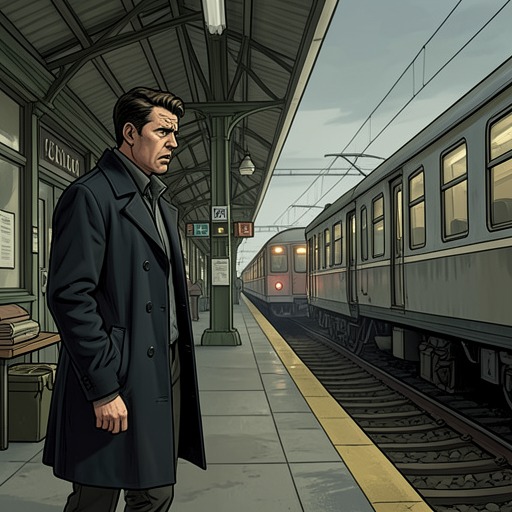
The novel places Kholby in a clearing about fifteen miles beyond Rothal, amid a landscape of date palms and acacias. Bungalows and workmen’s cabins stand nearby. The scene is not a detailed portrait of the settlement; its significance comes from its position on the travelers’ route and from the railway that ends there. A conductor’s call for passengers to get out turns a passing train journey into a sudden stop in the middle of a wooded landscape.
That stop occurs along the Great Indian Peninsula Railway, whose general route runs from Bombay toward Calcutta. In the account of the line, it crosses the Western Ghauts, runs northeast, skirts the nearly independent territory of Bundelcund, ascends to Allahabad, and then turns east toward Calcutta. Kholby lies on the part of the route where the expected connection to Allahabad fails: the line is not continuous, and the track begins again only after a fifty-mile gap. The village thus marks a break in the railway’s practical geography, even as the route on paper suggests a journey across India by train.
The Railway’s Unfinished Promise
The interruption contrasts with the confidence surrounding railway travel. Earlier, the opening of the section between Rothal and Allahabad had been invoked to explain how a traveler could circle the world in eighty days. The railway was presented as evidence that distance had been compressed by modern transport. Yet at Kholby the passengers discover that the reported completion was premature. The newspapers, the conductor explains, had announced the whole line as open, although the section between Kholby and Allahabad remained unfinished.
The novel places that discrepancy against a larger account of changing travel in India. Earlier journeys, it says, depended on walking, riding, palanquins, or cumbersome coaches; now steamers and railways offered faster movement, and the Great Indian Peninsula Railway was described as crossing the peninsula between Bombay and Calcutta in three days. But even this new network could not guarantee an unbroken passage. Its Bombay–Calcutta route was not direct, and its actual distance exceeded the straight-line distance by more than a third. At Kholby, the limitation is more immediate: there is no track through the full stretch, so speed on the railway cannot carry passengers across the missing link.
Passengers and the Search for a Way Forward
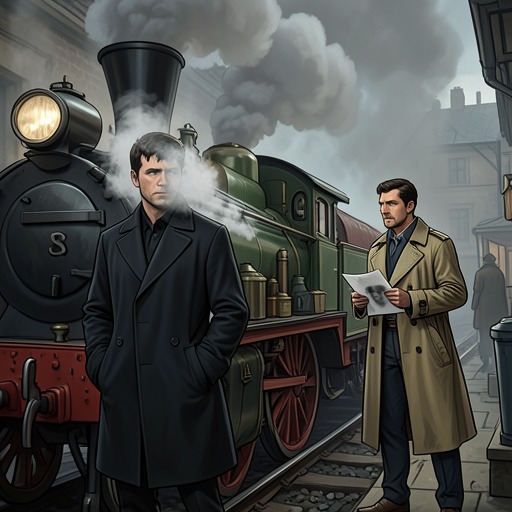
The train reaches its stopping place at eight o’clock, and the conductor tells the passengers to disembark. Phileas Fogg looks to Sir Francis Cromarty for an explanation; the general, no less than the others, does not understand why they have halted. Passepartout goes out to investigate and returns to report that the railway has ended. When Sir Francis asks where they are, the answer is Kholby; when he asks whether the train stops there, the conductor confirms that the line is not finished.
The discovery produces different responses. Sir Francis is furious, while Passepartout is so angry that he would willingly knock the conductor down, though he does not dare look at his master. Phileas Fogg remains composed and proposes that he and Sir Francis look for a means of reaching Allahabad. He is not surprised by the possibility of a delay: he says that some obstacle was to be expected and that he has two days already gained to sacrifice. His immediate schedule still allows time to reach Calcutta for a steamer to Hong Kong leaving at noon on the twenty-fifth; it is the twenty-second. His calm does not make the missing railway disappear, but it turns the disruption into a problem of finding another mode of conveyance.
The travelers search the village from end to end without finding what they need. Other passengers begin hiring whatever transport is available locally, including four-wheeled palkigharis, wagons drawn by zebus, carriages, palanquins, and ponies. This inventory gives the railway gap a material consequence: a timetable and a line on a map do not themselves carry anyone across the unfinished ground. At Kholby, onward movement depends on vehicles and arrangements outside the railway system.
Narrative Significance
Kholby makes the novel’s argument about a shrinking world more complicated. Faster railways and steamers make an eighty-day circumnavigation imaginable, but their apparent compression of distance is vulnerable to incomplete construction, inaccurate announcements, and the need to find alternative transport. The station is not simply a point on a fast route; it is where the limits of that route become visible. The journey’s progress depends on connections between systems, not on the railway alone.
The place also establishes a contrast between the passengers’ reactions and Phileas Fogg’s method. The halt is unexpected in its circumstances, but he treats the possibility of an obstacle as already accounted for and measures the delay against the time he has gained. Kholby therefore tests the practical value of his schedule: punctuality cannot prevent an interruption, but his reserve of time lets him respond without abandoning the journey. The hamlet’s brief appearance has lasting narrative force because a reported opening gives way, on the ground, to an unfinished line and a necessary search for another way onward.